






Executive Summary:
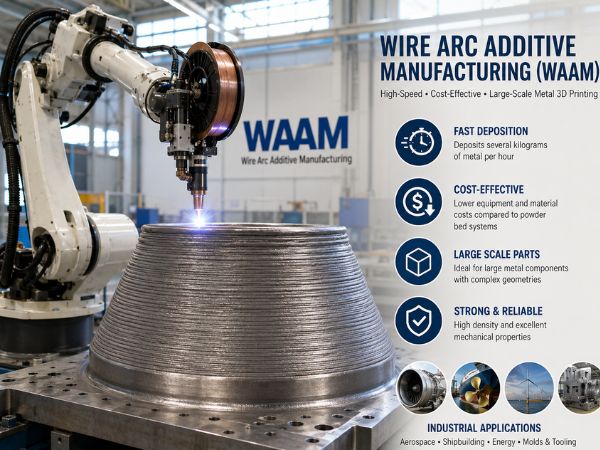
- What is WAAM? Wire Arc Additive Manufacturing (WAAM) is a high-speed metal 3D printing method. It uses electric arc welding tools guided by industrial robots to build metal parts layer by layer.
- Main Advantage: It deposits metal very quickly. This makes it the cheapest way to print large metal parts compared to powder-based metal 3D printers.
- Core Challenge: Managing heat buildup during long prints and keeping every part uniform.
- Future Outlook: Smart sensors and real-time digital tracking are moving WAAM from research labs into active factory production lines.
Table of Contents
1. What is Wire Arc Additive Manufacturing?
Building huge metal parts like rocket fuel tanks, ship propellers, and crane arms used to take months of heavy forging and cutting. Today, engineers build these same large parts in days using Wire Arc Additive Manufacturing (WAAM).
WAAM is a direct energy deposition (DED) process. It combines standard electric arc welding equipment with automated robotic arms. Instead of melting expensive metal powders with lasers, WAAM uses an electric arc to melt metal wire. The robot moves the torch along a planned path, depositing molten metal line by line and layer by layer to form a near-net-shape metal object.
       [ Robotic Arm ]
              │
         ( Wire Feed ) ─── Raw Metal Wire
              │
         ( Electric Arc ) ── Heat Source
              │
         [ Melt Pool ] ─── Liquid Metal Zone
              │
     [ Deposited Layers ] ── Layer-by-Layer Stacking
              │
 [ Near-Net-Shape Component ] ── Final Metal Shape
Why Factories Use WAAM
- Fast Printing: WAAM can deposit several kilograms of metal every hour. That is far faster than laser powder bed fusion printers.
- Less Wasted Metal: Machining a part from a solid metal block often wastes up to 90% of the raw material. WAAM prints close to the final shape, so machine tools only need to trim a thin outer layer.
- Lower Equipment Costs: WAAM uses standard welding power supplies and industrial robots, keeping initial hardware costs lower than giant laser systems.
2. Physical Parts of a WAAM System
A standard WAAM setup relies on five main physical elements working together during a print:
- Wire Feed (送丝): A mechanical feeder pushes raw metal wire into the build area at a steady, controlled speed.
- Electric Arc (电弧): An intense plasma arc forms between the welding torch and the base metal, generating heat to melt the wire.
- Melt Pool (熔池): The liquid metal area on the target surface where the fresh wire melts and fuses with the layer beneath it.
- Deposited Layer (沉积层): The solid metal track created as the arc moves forward and the liquid metal cools.
- Near-Net-Shape Component (近净成形构件): The stacked 3D metal preform that needs only light CNC machining to reach exact final dimensions.
3. The 5 Main Process Routes
The heat source you choose determines how fast you can print, how much heat enters the part, and how smooth the final surface looks. Engineers use five main process routes:
| Process Route | Full Name | Main Traits & Best Use Cases |
|---|---|---|
| GMAW | Gas Metal Arc Welding | Fast deposition and high efficiency; best for building large structural shapes quickly. |
| GTAW | Gas Tungsten Arc Welding | High accuracy and extremely clean welds; allows separate control over wire feed and heat. |
| PAW | Plasma Arc Welding | Deep penetration and a focused energy beam; offers steady arc performance. |
| CMT | Cold Metal Transfer | Controlled short-circuit process with low heat input; reduces spatter and warping. |
| Hybrid Heat Sources | Combined Heat Methods | Mixes electric arcs with secondary energy sources (such as lasers) for greater path control. |
4. Four Physics Fields in the Melt Pool
Four physical behaviors occur at the same time inside the molten metal pool. Controlling this Thermal-Fluid-Mass-Stress Coupling (热-流-质-应力耦合) keeps the print stable and dense.
- Temperature Field (温度场): Tracks how fast the metal heats up and cools down. This controls how the metal solidifies across layers.
- Flow Field (流动场): Governs how molten metal moves inside the pool due to fluid motion and surface tension forces (Marangoni flow).
- Mass Transfer Field (传质场): Manages how chemical elements move, how wire droplets detach, and how alloys mix in the liquid pool.
- Stress Field (应力场): Measures internal forces caused by expansion and contraction as the printed metal expands when hot and shrinks when cold.
5. Key Process Control Parameters
To print clean, smooth metal beads, operators adjust four main parameters. Think of these four settings as the core recipe for a good print:
- Heat Input (热输入): The amount of electrical energy delivered per millimeter of weld path. High heat makes the melt pool too large, while low heat causes poor fusion between layers.
- Interpass Temperature (层间温度): The temperature of the previously printed layer before depositing the next one. Waiting for the right cooling temperature prevents heat from building up out of control.
- Wire Feed Speed (送丝速度): How many meters of wire feed into the arc per minute. This directly sets how much metal deposits over time.
- Travel Speed / Walking Speed (行走速度): How fast the robotic arm moves the welding torch along the path. Travel speed controls the height and width of each printed track.
6. In-Situ Online Monitoring & Smart Sensing
Because large WAAM parts can take days to print, real-time inspection system tools catch errors early before material goes to waste. Modern machines rely on five types of sensors:
- Visual Sensing (视觉): High-speed optical cameras photograph the bead width, layer height, and torch position.
- Infrared Sensing (红外): Thermal cameras read surface temperatures and map cooling rates across the part.
- Optical Spectra Sensing (光谱): Spectrometers study the light given off by the arc to check shielding gas purity and plasma quality.
- Acoustic Sensing (声学): Microphones listen to arc sounds. Shifts in frequency warn operators about arc instability or cracking.
- Electrical Signal Sensing (电信号): Fast voltage and current sensors verify electrical stability and monitor how metal droplets separate from the wire.
7. Typical Materials Used in WAAM
WAAM works with standard commercial welding wires across five primary metal families:
- Titanium Alloys (钛合金 – Ti): Popular in aerospace because they are strong, lightweight, and resist rust (such as Ti-6Al-4V).
- Aluminum Alloys (铝合金 – Al): Lightweight metals used in cars, trucks, and boats. They require careful heat control to prevent defects.
- Steels (钢 – Fe/Steel): Carbon steels and stainless steels used to build heavy machinery, building frames, and industrial pipelines.
- Nickel-Based Alloys (镍基): High-temp alloys like Inconel 625 and 718 built for jet engines and harsh chemical processing units.
- Copper Alloys (铜合金 – Cu): Metals that conduct heat and electricity extremely well, useful for heat exchangers and boat fittings.
8. Microstructure & Common Defects
Repeated heating and cooling cycles during printing create specific internal grain patterns and mechanical defects:
- Anisotropy (各向异性): The printed part is stronger in one direction than another. This happens because long columnar grains grow vertically along the direction of heat flow.
- Residual Stress (残余应力): Internal tension trapped inside the cooled metal. Unchecked stress causes the finished part to twist, warp, or bend.
- Porosity (气孔): Tiny gas pockets trapped inside the solidifying metal, usually caused by moisture or dirty wire.
- Cracking (裂纹): Small or large fractures caused by extreme thermal stress or weak grain boundaries during cooling.
9. Strengthening and Post-Processing Methods
Engineers use mechanical and thermal treatments during or after the print to remove internal defects and increase strength:
- In-Situ Rolling (轧制): Heavy rollers press down on each hot metal track right after deposition to flatten the layer and relieve tension.
- Hammering / Peening (锤击): Mechanical hammers tap the top of the deposited layer to break up long columnar grains and create helpful compressive stress.
- Ultrasonic Impact Treatment (超声冲击): High-frequency sound vibrations strike the surface layer to reduce internal stress and refine grain size.
- Post-Print Heat Treatment (热处理): Heating the finished component inside an industrial furnace evens out the grain structure and reduces brittleness.
10. Real-World Engineering Applications
Factories run WAAM production across four primary industrial sectors:
- Aerospace & Space (航空航天): Making large structural ribs, mounting brackets, rocket engine frames, and fuel tank shells.
- Shipbuilding & Maritime (船舶): Printing custom bronze ship propellers, shaft supports, and thick hull support beams.
- Energy Sector (能源): Building nuclear reactor caps, offshore wind turbine joints, and heavy oil pipelines.
- Molds & Tooling (模具): Fabricating and repairing large metal stamping dies, injection molds, and heavy forging tools.
11. The 5-Step Roadmap to Industrial WAAM Adoption
Moving WAAM from a test laboratory to a commercial factory floor requires a clear five-step plan:
┌──────────────────────────┐
│ Step 1: Equipment &      │ ── Choose Hardware, Select Process Routes &
│         Process          │    Tune Base Parameters
└────────────┬─────────────┘
             ▼
┌──────────────────────────┐
│ Step 2: Forming          │ ── Track Thermal-Fluid-Mass-Stress
│         Mechanism        │    Coupling in the Pool
└────────────┬─────────────┘
             ▼
┌──────────────────────────┐
│ Step 3: Sensing &        │ ── Install In-Situ Sensors & Closed-Loop
│         Control          │    Control Software
└────────────┬─────────────┘
             ▼
┌──────────────────────────┐
│ Step 4: Quality &        │ ── Fix Grain Patterns, Eliminate Defects &
│         Performance      │    Test Mechanical Strength
└────────────┬─────────────┘
             ▼
┌──────────────────────────┐
│ Step 5: Industrial       │ ── Complete Industry Testing, Set Quality
│         Application      │    Standards & Scale Up Production
└──────────────────────────┘
- Equipment & Process Setup (装备与工艺): Select the robotic platform, pick the power supply, set baseline parameters, and program toolpaths.
- Forming Mechanism Understanding (成形机理): Model how heat, fluid flow, mass, and internal stress behave together during deposition.
- Sensing & Control Integration (感知与控制): Add real-time sensors, automated feedback software, and smart decision tools to maintain print quality.
- Quality & Performance Control (质量与性能): Refine metal grain structures, stop porosity and cracks, and test final fatigue resistance.
- Industrial Application & Scale (产业应用): Complete full-scale testing on real factory parts, write official industry standards, and start full production.
12. Frequently Asked Questions (FAQ)
Q1: How does WAAM differ from Powder Bed Fusion (PBF) metal 3D printing?
Answer: WAAM uses metal wire and an electric arc to build large parts quickly, while Powder Bed Fusion uses fine metal powder and lasers to print smaller, more intricate parts slowly. Powder bed systems offer finer surface detail, but WAAM prints meters-wide parts at a fraction of the cost.
Q2: Is WAAM cheaper than traditional metal forging or CNC machining?
Answer: Yes, WAAM saves money on large, low-volume metal parts by reducing material waste and shortening lead times. It cuts lead times from months down to days and reduces the Buy-to-Fly ratio (the weight of starting material compared to the finished part) from 10:1 down to nearly 1.2:1.
Q3: What is the main challenge in industrial WAAM production today?
Answer: Managing heat accumulation during long print cycles remains the single biggest challenge in WAAM production. Uncontrolled heat alters the size of the melt pool, lowers dimensional accuracy, and creates internal stresses. Automated sensor controls and digital tracking tools are helping solve this issue.
About the Author: Felix Lee is the CEO at Forgecise, an advanced additive manufacturing technology enterprise. Felix specializes in robotic wire-arc deposition, automated toolpath planning, and smart sensing systems for industrial metal fabrication.