







Written by Felix Lee, CEO at Forgecise
Published: July 31, 2026
Last updated: July 31, 2026
Expertise: Metal Additive Manufacturing | Robotic Welding | Industrial Automation
Table of Contents
Quick Answer
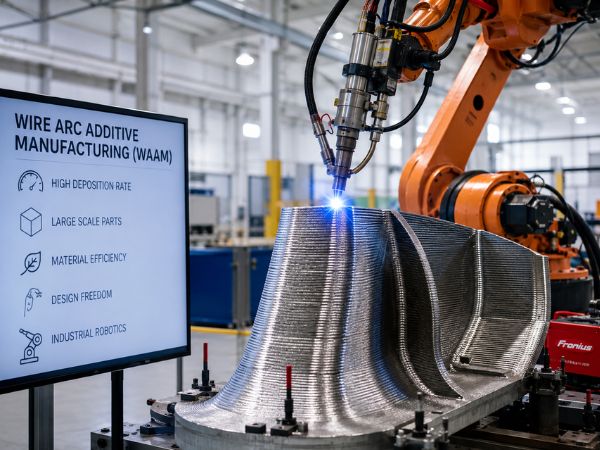
Wire Arc Additive Manufacturing, or WAAM, is a directed energy deposition process that uses an electric arc to melt metal wire and build near-net-shape components layer by layer. It is particularly valuable for medium-to-large metal parts because it combines high deposition productivity, widely available wire feedstock, flexible robotic motion, and lower feedstock handling complexity than many powder-based processes.
TL;DR: What Engineers Need to Know
- A WAAM cell combines an arc process, wire delivery, motion control, shielding, sensing, and process software.
- GMAW offers high productivity, while GTAW and PAW provide greater separation between the heat source and filler wire.
- CMT reduces heat input and spatter through controlled short-circuit metal transfer.
- Multi-wire and hybrid systems target higher throughput, material tailoring, or improved process control.
- Thermal history—not deposition speed alone—often determines distortion, residual stress, microstructure, and final part quality.
- Process selection must consider alloy behavior, geometry, qualification requirements, machining allowance, and total production cost.
Wire Arc Additive Manufacturing looks simple from across the workshop: a robot, a welding torch, and a bright arc laying down metal.
Up close, it is a different story.
A stable industrial build depends on dozens of interactions between wire position, travel speed, current, shielding gas, interpass temperature, bead geometry, toolpath strategy, and the stiffness of the motion platform. A system can deposit metal quickly and still produce a part that is difficult—or impossible—to qualify.
That is why WAAM should be evaluated as a complete manufacturing architecture, not merely as automated welding.
What Is Wire Arc Additive Manufacturing?
Wire Arc Additive Manufacturing is a metal additive-manufacturing method in which focused thermal energy from an electric arc melts wire feedstock as it is deposited onto a substrate or previous layer.
WAAM falls within the broader directed energy deposition family. International terminology describes DED as a process in which focused thermal energy fuses material as it is being deposited. Wire-and-arc processes are also addressed specifically in aerospace-oriented ISO/ASTM process standards.
A typical workflow follows this sequence:
CAD model → build orientation → slicing → toolpath generation → parameter assignment → wire deposition → monitoring → inspection → machining or heat treatment
Unlike subtractive manufacturing, WAAM adds material only along the programmed deposition path. However, most industrial WAAM parts are not removed from the machine ready for service.
They commonly require some combination of:
- Substrate removal
- Stress-relief heat treatment
- Hot isostatic pressing for selected applications
- CNC machining
- Surface finishing
- Non-destructive inspection
- Mechanical-property verification
- Dimensional inspection
Here is the practical point: WAAM often reduces the amount of material that must be purchased and removed, but it does not eliminate downstream manufacturing.
Why Is WAAM Used for Large Metal Components?
WAAM is primarily used when part size, material cost, lead time, or deposition productivity makes powder-bed manufacturing less attractive.
Its most compelling applications usually involve large, relatively low-to-medium-complexity metal volumes rather than tiny internal channels or highly detailed as-built surfaces.
Typical application areas include:
- Aerospace ribs, frames, stiffeners, and near-net-shape structural preforms
- Marine and shipbuilding components
- Energy-sector parts and repair features
- Large tooling, dies, and molds
- Defense and heavy-equipment structures
- Replacement components with long conventional lead times
- Functionally graded or multi-material research builds
The business case improves when the original component has a poor buy-to-fly ratio. In other words, conventional production may begin with a large billet or forging and machine away a substantial portion of the material.
WAAM can deposit a shape closer to the final geometry.
Still, deposited mass alone does not prove savings. A useful cost model should also include programming, trial builds, shielding gas, fixtures, sensors, inspection, machining, qualification, scrap risk, and operator time.
What Equipment Does an Industrial WAAM System Need?
A functional WAAM system requires six core subsystems: motion, heat generation, wire delivery, shielding, thermal management, and control with monitoring.
The exact hardware configuration changes with component size and process route. A six-axis robot may be ideal for curved toolpaths, while a gantry may provide better working volume and stiffness for very large parts. Some cells combine both.
1. Motion Platform
The motion platform positions the torch, wire, workpiece, or a combination of all three.
Common configurations include:
- Six-axis industrial robots
- Cartesian gantries
- Robot plus positioner
- Gantry plus rotary table
- Multi-robot synchronized cells
Robot reach should never be confused with usable deposition accuracy. Payload, path speed, joint configuration, thermal drift, fixture stiffness, cable routing, and calibration all affect the actual result.
A robot may repeat a programmed point accurately while the deposited bead still moves because the wire bends, the substrate distorts, or the torch-to-work distance changes.
2. Welding Power Source and Arc Process
The power source controls current, voltage, waveform, pulse behavior, and metal-transfer mode.
Its selection determines more than arc intensity. It influences:
- Droplet transfer
- Heat input
- Penetration
- Spatter
- Arc stability
- Bead width
- Dilution
- Deposition productivity
Power-source commands should be synchronized with motion and wire-feed control. Delayed starts, unstable ignition, or poorly timed crater filling can create defects at every toolpath transition.
3. Wire-Feeding System
The wire feeder delivers filler material into the arc or melt pool at a controlled rate.
A reliable feeding system should maintain:
- Stable wire-feed speed
- Repeatable wire position
- Suitable contact-tip condition
- Low slip and backlash
- Correct wire straightening
- Controlled spool tension
- Consistent feed during acceleration and turns
This subsystem is easy to underestimate.
A laboratory team may spend days tuning current and travel speed when the real problem is a wire liner dragging intermittently during a robot wrist rotation.
4. Torch, Contact Tip, and Deposition Head
The deposition head delivers arc energy, filler wire, and shielding gas to the build zone.
Depending on the process, the head may include:
- GMAW torch
- GTAW torch with external wire nozzle
- Plasma torch
- CMT-compatible torch
- Multi-wire feeding arrangement
- Laser-arc hybrid head
- Coaxial or side-fed wire delivery
Torch accessibility matters early in part design. A geometry that is easy to slice may still cause collision risks, poor gas coverage, or unstable wire entry angles.
5. Shielding and Environmental Control
Shielding gas protects the molten pool and hot metal from atmospheric contamination.
The required setup depends heavily on the alloy. Local torch shielding may be sufficient for some steels, while reactive materials such as titanium can require trailing shields, enclosed chambers, or extensive environmental control.
Important variables include:
- Gas composition
- Flow rate
- Nozzle geometry
- Draft protection
- Oxygen concentration
- Trailing coverage
- Gas pre-flow and post-flow time
More gas is not automatically better. Excessive flow can create turbulence and draw surrounding air into the protected zone.
6. Cooling and Thermal Management
Cooling protects equipment and helps regulate the part’s thermal cycle.
A WAAM cell may use:
- Water-cooled torches
- Cooled fixtures
- Active substrate cooling
- Interpass dwell periods
- Forced gas cooling
- Temperature-triggered path pauses
- Alternating deposition sequences
Thermal control should be based on the alloy and target microstructure, not just the need to keep the torch from overheating.
7. Sensors and Process-Monitoring Hardware
Modern WAAM systems may monitor geometry, temperature, electrical behavior, acoustic emissions, and spatial position.
Common sensors include:
- Melt-pool or arc cameras
- Infrared cameras
- Optical pyrometers
- Laser profilometers
- Structured-light scanners
- Current and voltage acquisition
- Acoustic sensors
- Force or touch probes
- External robot-tracking systems
A pose sensor alone does not guarantee layer accuracy. The strongest monitoring strategies combine machine-state data with direct observation of the bead or deposited geometry.
Which WAAM Process Routes Are Most Common?
The main WAAM routes use GMAW, GTAW, PAW, controlled short-circuit processes such as CMT, multi-wire configurations, or hybrid heat sources.
Each route solves a different engineering problem. There is no universal winner.
How Does GMAW-Based WAAM Work?
GMAW-based WAAM uses a continuously fed consumable wire as both the electrode and filler material.
It is widely used because industrial welding equipment is readily available and the process can achieve strong deposition productivity. It is often suitable for steels, aluminum alloys, and large structural builds.
Strengths
- High deposition potential
- Mature equipment ecosystem
- Straightforward wire delivery
- Competitive capital cost
- Strong suitability for large metal volumes
Limitations
- Metal-transfer behavior directly affects bead stability
- Greater spatter risk in unsuitable transfer modes
- Higher heat input in many operating windows
- Surface waviness can increase machining allowance
- Arc behavior may change around starts, stops, and corners
GMAW is often a sensible baseline for a large steel structure. It becomes less attractive when the component has delicate walls, strict heat limits, or demanding as-built geometry.
When Is GTAW-Based WAAM a Better Choice?
GTAW-based WAAM uses a non-consumable tungsten electrode to create the arc while a separate wire feeder supplies filler metal.
Separating the heat source from the wire gives engineers greater control over wire placement and thermal input. The trade-off is usually lower deposition productivity and a more sensitive relationship between the torch, wire, and melt pool.
Strengths
- Stable, clean arc
- Low spatter
- Independent control of wire and arc
- Good bead and melt-pool visibility
- Suitable for precision-oriented development
Limitations
- Lower deposition rate in many configurations
- Wire-position alignment is critical
- More variables must be synchronized
- Tungsten contamination must be prevented
- Large builds can become time-intensive
GTAW is often useful when process control matters more than maximum deposited kilograms per hour.
What Does PAW Add to the WAAM Process?
Plasma Arc Welding constricts the arc through a nozzle, producing a concentrated and stable heat source.
PAW can offer stronger arc directionality and greater energy density than conventional GTAW. It is used for controlled deposition, thicker features, and research involving demanding alloys or geometries.
Strengths
- Concentrated energy input
- Stable, directed arc
- Independent filler-wire control
- Potential for controlled penetration
- Suitable for automated precision processes
Limitations
- More complex torch and gas arrangement
- Nozzle condition affects performance
- Parameter development can be demanding
- Capital and maintenance requirements may be higher
- Excessive penetration can become a problem in thin walls
PAW is valuable when the process window benefits from a narrow, controlled heat source. It is not automatically superior for every thick-walled component.
Why Is CMT Popular for WAAM?
Cold Metal Transfer is a controlled GMAW process that coordinates current waveforms with wire motion during short-circuit metal transfer.
Its controlled droplet detachment can reduce spatter and heat input compared with conventional short-circuit GMAW. These properties make CMT particularly attractive for aluminum alloys, thin walls, dissimilar-material studies, and builds sensitive to thermal accumulation.
Strengths
- Relatively low heat input
- Controlled metal transfer
- Low spatter
- Good thin-wall capability
- Strong compatibility with aluminum processing
Limitations
- Proprietary equipment ecosystem
- Parameter transfer between machines may be difficult
- “Cold” does not mean the build remains thermally cool
- Heat still accumulates during long deposition cycles
- Mechanical properties still depend on path planning and thermal history
This is where teams sometimes get caught out: they select CMT, assume the heat problem is solved, and then run a long uninterrupted wall.
Several hundred layers later, interpass temperature has drifted far beyond the original process-development window.
What Is Multi-Wire WAAM?
Multi-wire WAAM feeds two or more wires into one melt pool or coordinated arc arrangement.
The goal may be to increase deposition rate, create in-situ alloy compositions, produce graded materials, or combine expensive and inexpensive feedstocks more strategically.
Potential advantages
- Higher mass deposition
- Expanded alloy-design possibilities
- Functionally graded structures
- Improved throughput for large builds
- Flexible material composition
Engineering challenges
- More complex wire positioning
- Uneven melting between wires
- Composition control
- Larger or less stable melt pools
- Higher total heat input
- More demanding process monitoring
Multi-wire systems can be fast. They can also amplify every weakness in the cell.
If the fixture, thermal strategy, or bead-control model is marginal with one wire, doubling the feedstock rarely makes the process easier.
How Do Hybrid Laser-Arc or Plasma-Arc Systems Work?
Hybrid WAAM combines an electric arc with another energy source, commonly a laser or plasma process.
The additional heat source may stabilize the melt pool, modify penetration, preheat the wire or substrate, improve deposition behavior, or expand the usable process window.
Potential advantages
- Higher processing speed
- More flexible penetration control
- Improved arc stability in selected configurations
- Greater control of bead geometry
- Opportunities for difficult materials
Limitations
- Higher equipment cost
- Complex calibration
- Increased safety requirements
- More parameters and failure modes
- Stronger need for synchronized control
A hybrid head should solve a defined production constraint. Adding a laser because it sounds advanced is an expensive way to complicate a process that may already work with a conventional arc.
How Do the Main WAAM Processes Compare?
The ratings below are relative engineering guidelines, not universal performance guarantees. Actual results depend on the alloy, equipment, transfer mode, wall geometry, and parameter window.
| WAAM route | Deposition potential | Heat-control potential | Geometric control | Spatter control | Typical fit |
|---|---|---|---|---|---|
| GMAW | High | Moderate | Moderate | Low to moderate | Large steel or aluminum structures |
| GTAW | Low to moderate | High | High | High | Precision walls and controlled development |
| PAW | Moderate | High | High | High | Concentrated-arc, performance-focused builds |
| CMT | Moderate to high | High | High | High | Aluminum, thin walls, low-spatter deposition |
| Multi-wire | Very high | Low to moderate | Moderate | Process-dependent | Extra-large parts and composition tailoring |
| Hybrid laser-arc | High | High | High | High | High-value parts with a defined hybrid-process benefit |
WAAM Selection Checklist
Before selecting a route, answer these questions:
- What alloy will be deposited?
- How reactive is the material at elevated temperature?
- What wall thickness and bead width are required?
- Is productivity or geometric accuracy the primary constraint?
- How much machining allowance is acceptable?
- What interpass temperature range must be maintained?
- Which defects are most critical for the application?
- What inspection and qualification standards apply?
- Does the part require multi-axis deposition?
- Can the expected production volume justify specialized equipment?
How Does a Closed-Loop WAAM System Work?
A closed-loop WAAM system measures the deposition process and adjusts selected variables to keep the build within a defined operating window.
The architecture typically contains six functional stages:
Digital plan → motion and process commands → arc and wire deposition → in-process sensing → feature extraction → control correction
Stage 1: Digital Planning
The controller receives build geometry, toolpaths, process parameters, and sequencing rules.
Useful planning data may include:
- Layer height
- Bead overlap
- Torch orientation
- Start and stop strategy
- Interpass temperature limit
- Travel direction
- Dwell time
- Expected deposition volume
Stage 2: Motion Execution
The robot, gantry, or positioner follows the programmed toolpath.
The controller must coordinate acceleration, process starts, wire feed, gas timing, and torch orientation. Corners and direction changes are especially important because travel speed may fall even when wire feed remains constant.
That mismatch can create a local bulge in seconds.
Stage 3: Arc and Material Deposition
The power source establishes the arc while the wire system supplies material.
The deposited bead is governed by interacting variables rather than one isolated setting. Current, voltage, wire-feed speed, travel speed, contact-tip distance, torch angle, and substrate temperature all matter.
Stage 4: Melt-Pool and Bead Formation
The molten pool transfers heat into the previous layer and substrate before solidifying.
At this stage, the process determines:
- Fusion quality
- Dilution
- Bead width and height
- Solidification direction
- Grain growth
- Porosity risk
- Residual-stress development
Stage 5: Online Monitoring
Sensors measure selected indicators such as temperature, layer height, bead profile, arc behavior, or wire position.
Raw sensor data is not yet a control decision. It must be filtered, synchronized, interpreted, and compared with a target or process model.
Stage 6: Feedback and Correction
The system adjusts a controllable variable.
Possible corrections include:
- Travel speed
- Wire-feed speed
- Current or waveform
- Torch-to-work distance
- Layer offset
- Dwell time
- Cooling duration
- Toolpath position
Closed-loop control works best when one correction has a predictable relationship with the monitored feature. Changing several variables simultaneously may hide the true cause of instability.
Which Parameters Have the Greatest Effect on WAAM Quality?
The most influential parameters are heat input, wire-feed speed, travel speed, interpass temperature, torch geometry, shielding, and toolpath strategy.
They should be treated as a connected process window.
Heat Input and Interpass Temperature
High heat input can increase melt-pool size and deposition capability, but it may also increase distortion, grain growth, residual stress, and loss of dimensional control.
Published research consistently identifies a trade-off between deposition productivity and thermal load. Higher deposition rates commonly require more energy and can intensify thermal-management problems.
Interpass temperature is therefore one of the most useful practical control variables. It provides a measurable link between one layer’s thermal history and the next layer’s behavior.
Wire-Feed Speed and Travel Speed
Wire-feed speed controls incoming material volume. Travel speed distributes that volume along the path.
When wire feed rises without a proportional change in motion, the bead generally becomes larger. When travel speed increases too far, lack of fusion or discontinuous deposition may occur.
The ratio matters, but it cannot be separated from current, transfer mode, and thermal state.
Torch Angle and Wire Position
Wire entry angle affects how droplets enter the melt pool.
Small alignment errors can cause:
- Sidewall asymmetry
- Unstable transfer
- Wandering bead centers
- Incomplete fusion
- Contact-tip wear
- Wire stubbing
This becomes especially important in multi-axis builds, where gravity and torch orientation change along the toolpath.
Shielding-Gas Coverage
Poor shielding can introduce oxidation, nitrogen pickup, porosity, or surface contamination.
Reactive alloys deserve particular attention because a visually acceptable bead may still have degraded chemistry or mechanical properties.
Toolpath and Deposition Sequence
Toolpath planning determines where heat is added and how long each region cools.
Useful strategies include:
- Alternating travel direction
- Segmenting long paths
- Balancing deposition around the substrate
- Rotating start points
- Depositing symmetric features in sequence
- Using temperature-based dwell times
- Avoiding repeated heat concentration in one region
The toolpath is part of the metallurgy.
It should not be treated as a neutral geometric instruction.
What Defects and Production Risks Should Engineers Expect?
WAAM risks include distortion, residual stress, lack of fusion, porosity, cracking, anisotropy, surface waviness, and inconsistent layer height.
Distortion and Residual Stress
Repeated heating and cooling create local expansion and contraction. If fixtures, path planning, and interpass control are inadequate, the substrate or build may bend progressively.
Porosity
Porosity can be linked to contamination, unstable shielding, moisture, hydrogen pickup, wire condition, or melt-pool behavior. Aluminum and other sensitive alloys require disciplined feedstock storage and surface preparation.
Lack of Fusion
Lack of fusion occurs when deposited material does not properly bond with the previous layer or adjacent bead.
Possible causes include:
- Insufficient energy
- Excessive travel speed
- Incorrect torch position
- Oxide contamination
- Poor bead overlap
- Unfavorable geometry
Cracking
Cracking risk depends on alloy chemistry, restraint, thermal gradient, solidification behavior, and residual stress. Some alloys that are straightforward to weld are still difficult to build repeatedly through hundreds of thermal cycles.
Anisotropy and Microstructural Variation
Directional heat flow can create columnar grains and different mechanical behavior across build orientations.
Qualification should therefore use specimens and inspection plans that represent the actual component, deposition direction, and heat treatment.
What Are Three Rules for Reliable WAAM Production?
Three principles consistently separate stable industrial builds from impressive demonstrations.
Rule 1: Control Thermal History, Not Just Arc Power
A fixed power setting does not produce a fixed thermal condition across a long build.
The substrate is cold at the start. Later layers are deposited onto a hot component with different heat-flow behavior.
Monitor interpass temperature and build a cooling strategy into the program.
Rule 2: Treat Mechanical Stability as a Process Variable
Software cannot compensate indefinitely for a flexible fixture, worn contact tip, slipping wire feeder, or poorly calibrated robot.
Before adding artificial intelligence, make the physical process repeatable.
That sounds basic because it is. It is also where many expensive development programs lose time.
Rule 3: Optimize Total Production, Not Maximum Deposition Rate
The fastest deposition parameter may create the largest machining allowance, the worst distortion, or the greatest inspection risk.
The meaningful target is not kilograms per hour in isolation.
It is qualified parts per week at an acceptable cost.
How Should a Company Evaluate a WAAM System?
Begin with a representative part and a measurable production objective.
A practical evaluation sequence is:
- Define alloy, geometry, annual volume, and performance requirements.
- Identify the existing manufacturing pain point.
- Select a process route based on the dominant constraint.
- Produce simple bead-on-plate and wall trials.
- Establish a stable process window.
- Measure thermal behavior and geometry.
- Build a representative feature or reduced-scale demonstrator.
- Define machining and inspection requirements.
- Compare full production cost with the incumbent process.
- Qualify the machine, procedure, operators, feedstock, and inspection plan as required.
A vendor demonstration should be treated as evidence of capability—not proof that the process is ready for your part.
Ask what alloy was used, how many trials were discarded, what post-processing was required, how dimensions were measured, and whether the displayed component passed mechanical and non-destructive testing.
Those questions change the conversation quickly.
Is WAAM Ready for Industrial Production?
Yes, WAAM is already used in advanced industrial and aerospace development, but production readiness depends on process qualification, repeatability, inspection, and application-specific standards.
ISO/ASTM 52943-2:2024 addresses process characteristics and performance requirements for aerospace-directed energy deposition using wire and arc. Broader additive-manufacturing standards also cover terminology, process qualification, data, operator competence, and production-site requirements.
The existence of standards does not make every WAAM cell production-ready.
A qualified system requires documented control over:
- Machine configuration
- Software and parameter revisions
- Feedstock identity and storage
- Calibration
- Build records
- Environmental conditions
- Inspection
- Non-conformance handling
- Operator responsibilities
What Is the Future of WAAM?
The next stage of WAAM development will focus less on proving that a robot can deposit metal and more on proving that the system can reproduce certified material and geometry.
The most important development areas include:
- Multi-sensor process monitoring
- Layer-by-layer geometry correction
- Digital twins
- Physics-informed control models
- Automated path replanning
- In-situ defect detection
- Standardized process data
- Multi-material deposition
- Hybrid additive and machining cells
- Qualification of complete production workflows
Artificial intelligence may support anomaly detection, parameter recommendations, and predictive maintenance.
But the manufacturing organization remains responsible for the result.
A model can flag an unusual melt-pool signal. It cannot decide, by itself, whether a safety-critical aerospace component is acceptable.
Final Engineering Perspective
WAAM is most valuable when it is matched to the right part.
It is not a universal replacement for forging, casting, machining, or powder-bed fusion. It is another manufacturing route—one with unusual advantages in scale, feedstock availability, deposition productivity, repair, and geometric flexibility.
The strongest WAAM programs begin with a production problem, not a machine specification.
They control heat. They measure what the process is doing. They leave enough material for finishing. And they qualify the complete route from wire spool to inspected component.
That is how WAAM moves from an impressive arc in a laboratory to a reliable industrial process.
Discuss Your WAAM Application
Forgecise works with industrial teams evaluating robotic metal deposition, custom additive-manufacturing equipment, motion architecture, and integrated production workflows.
For a useful technical discussion, prepare the target alloy, part dimensions, annual volume, existing manufacturing route, required tolerances, and inspection standard.
About the Author
Felix Lee is the CEO of Forgecise, an advanced-manufacturing and engineering-solutions provider. His work focuses on industrial additive manufacturing, robotic automation, equipment integration, and the transition from laboratory-scale technology to repeatable production systems.
Reviewer recommendation: Before publication, assign a named welding engineer, materials engineer, or additive-manufacturing specialist to verify the process-comparison table and alloy-specific claims.
Editorial note: This article is intended for engineering education and initial technology evaluation. Process parameters must be developed and qualified for the specific material, machine, geometry, safety requirements, and applicable industry standards.