




Written by Felix Lee, CEO at Forgecise
Last Updated: August 2026
Table of Contents
What Is Wire EDM Used for in Metal Additive Manufacturing?
Wire EDM (Wire Electrical Discharge Machining, or WEDM) is a precision cutting method used after metal 3D printing to remove build plates, separate support structures, and cut accurate profiles. Unlike traditional machining, Wire EDM removes material through electrical sparks instead of physical cutting force, making it suitable for stressed parts made by SLM and DED processes.
Quick Takeaways
- Wire EDM is widely used in metal additive manufacturing post processing.
- It helps remove printed parts from build plates with low deformation risk.
- Slow Wire EDM provides better accuracy and surface quality than Fast Wire EDM.
- Recast layer control is necessary for fatigue-sensitive components.
- Cutting sequence, machine settings, and inspection records determine final part quality.
Metal additive manufacturing has changed how engineers produce complex metal components. Processes such as Selective Laser Melting (SLM) and Directed Energy Deposition (DED) allow manufacturers to create lightweight structures, optimized designs, and parts that are difficult to produce with traditional methods.
However, printing is only the beginning.
After a metal part leaves the printer, engineers still need to remove the build plate, cut supports, improve surfaces, and prepare the component for final machining or inspection.
This stage can decide whether a part passes or fails.
A printed titanium component may have excellent internal geometry, but incorrect cutting methods can introduce distortion, surface damage, or unwanted stress release.
This is why Wire EDM has become an important process in metal additive manufacturing.
What Is Wire EDM and How Does It Work?
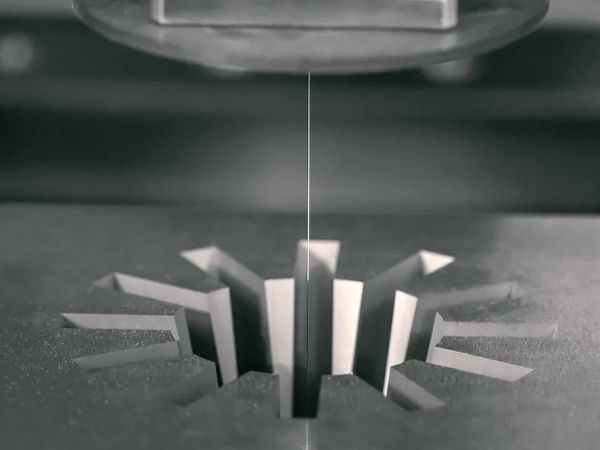
Wire EDM uses a thin moving metal wire as an electrode to remove material through controlled electrical discharge.
The process does not use a traditional cutting tool.
Instead, the machine creates thousands of small electrical sparks between the wire and the workpiece. Each spark produces intense local heat, melting a very small amount of material. The CNC system controls the wire movement and creates the required cutting path.
The basic process includes:
- A metal wire is positioned close to the workpiece.
- A pulsed electrical voltage is applied.
- Sparks form between the wire and the metal part.
- The high temperature removes material through erosion.
- The CNC system guides the wire along the programmed path.
Common electrode wires include:
- Brass wire
- Zinc-coated wire
- Molybdenum wire
The working fluid depends on the Wire EDM system:
- Slow Wire EDM normally uses deionized water.
- Fast Wire EDM commonly uses emulsion fluid.
Because the process creates almost no mechanical cutting force, Wire EDM works well for metal additive manufacturing parts that contain residual stress.
Why Is Wire EDM Suitable for Metal 3D Printed Parts?
The biggest advantage of Wire EDM is simple:
It cuts without pushing on the part.
Traditional machining creates cutting forces that can move thin walls, release stress, or damage fragile structures. Metal additive manufacturing parts often contain internal stress because they experience repeated heating and cooling during printing.
Wire EDM reduces these problems because:
- There is no direct cutting pressure.
- Hard materials can be processed.
- Thin walls are less likely to deform.
- High-strength alloys can be machined.
For example, a thin titanium alloy bracket printed by SLM may move during milling because the material is already under stress. Wire EDM can separate the part while keeping the original shape more stable.
How Is Wire EDM Used in Metal Additive Manufacturing Post Processing?
Wire EDM has several important applications after metal printing.
Removing Parts From the Build Plate
One of the most common uses is separating printed parts from the build platform.
SLM and DED components are usually connected to a metal substrate during printing. After printing, engineers need to remove the part without damaging the final geometry.
Wire EDM can cut through:
- Build plate connections
- Manufacturing tabs
- Support connections
The advantages include:
- Low heat influence
- Accurate separation
- Reduced deformation
- Better control of expensive metal parts
For aerospace and medical components, this controlled separation method is often preferred.
Removing Difficult Support Structures
Support removal can become difficult when structures are large, deep, or located in narrow areas.
Wire EDM can remove:
- Large support blocks
- Hard-to-access support areas
- Excess printed sections
- Precision slots and profiles
This makes it useful for:
- Thin-wall components
- Overhang structures
- Complex printed geometries
What Are the Limits of Wire EDM?
Wire EDM is powerful, but it does not replace every machining process.
It works best for:
- Through cutting
- Profile cutting
- Part separation
- Precision contour machining
However, Wire EDM cannot replace CNC machining for:
- Closed internal cavities
- Complex three-dimensional surfaces
- Full 3D shaping operations
A common production mistake is asking Wire EDM to perform a job designed for CNC.
A better workflow is:
Wire EDM → separation and contour preparation
CNC machining → final geometry and precision surfaces
Slow Wire EDM vs Fast Wire EDM: Which One Is Better?
There are two main Wire EDM approaches used in manufacturing.
| Feature | Slow Wire EDM | Fast Wire EDM |
|---|---|---|
| Wire movement | Single direction | High-speed recycled wire |
| Wire use | New wire used once | Wire reused |
| Accuracy | Higher | Lower |
| Surface quality | Better | Rougher |
| Cost | Higher | Lower |
| Main application | Precision parts | Rough cutting |
Slow Wire EDM (LS-WEDM)
Slow Wire EDM is the preferred option for high-value metal additive manufacturing parts.
Typical performance:
- Accuracy can reach approximately ±0.005 mm.
- Surface roughness can reach Ra below 1.6 μm.
- Fine finishing can reach around Ra 0.8 μm.
- Recast layer thickness is usually lower.
It is commonly used for:
- Aerospace components
- Titanium alloy parts
- Nickel-based superalloy components
- Precision engineering applications
Fast Wire EDM (HS-WEDM)
Fast Wire EDM uses a wire that moves quickly and is recycled.
Its advantages are:
- Higher cutting speed
- Lower operating cost
Its limitations include:
- Lower precision
- Rougher surface finish
- Higher wire wear
It is commonly used for:
- Support removal
- Rough cutting
- Tooling applications
What Wire EDM Parameters Control Cutting Quality?
Wire EDM quality depends on several machine settings working together. The wrong balance can create poor surface finish, thick recast layers, unstable cutting, or even part failure.
The main parameters include:
- Pulse duration
- Pulse interval
- Peak current
- Wire speed
- Wire tension
- Working fluid conductivity
- Working fluid temperature
These settings control three important results:
- Cutting speed
- Surface quality
- Thermal damage level
A faster cut is not always a better cut.
For metal additive manufacturing parts, especially aerospace components, surface condition is often more important than cutting speed.
How Do Pulse Energy and Current Affect Wire EDM Results?
The electrical energy of each discharge directly affects the final surface.
Higher energy settings provide faster material removal, but they also create more heat.
High-energy cutting may cause:
- Rougher surfaces
- Thicker recast layers
- Larger heat affected zones (HAZ)
- Higher risk of micro cracks
Lower energy settings create:
- Better surface finish
- Smaller thermal effects
- Reduced recast layer thickness
For titanium alloys and nickel-based superalloys, controlling single-pulse energy is especially important.
These materials are widely used in aerospace because they provide high strength and heat resistance. However, their properties also make them sensitive to uncontrolled thermal input.
A proper Wire EDM process must balance:
Material removal speed + Surface integrity + Thermal control
What Is the EDM Recast Layer and Why Does It Matter?
The recast layer is a thin melted and re-solidified layer left on the cutting surface after EDM processing.
During each electrical discharge, a small area of the material melts. Some of this melted material is removed by the working fluid, while the remaining material quickly cools and becomes a new surface layer.
This new layer is different from the original material.
For general industrial parts, a small recast layer may be acceptable.
For fatigue-sensitive components, such as aerospace engine parts, it can become a serious concern.
Possible risks include:
- Micro cracks
- Different surface structure
- Reduced fatigue performance
- Lower long-term reliability
This is one reason why aerospace manufacturers pay close attention to Wire EDM surface quality.
How Can Engineers Reduce Recast Layer Problems?
Several methods are used to control the recast layer.
Multiple Cutting Passes
A common method is:
Rough cut → Fine finishing cuts
The first cut removes most material quickly.
The finishing passes use lower electrical energy to improve the surface and remove damaged material.
Lower Discharge Energy
Reducing pulse energy helps create:
- Thinner recast layers
- Lower heat affected zones
- Better surface quality
Additional Surface Treatments
Depending on the part requirements, engineers may use:
- Sand blasting
- Electrochemical polishing
- Chemical milling
For fatigue-critical parts, the recast layer should be included in the manufacturing inspection plan.
Engineers may use metallographic analysis to confirm the surface condition.
A common surface requirement for precision components is:
Ra ≤1.6 μm
How Can Engineers Prevent Wire EDM Deformation?
Residual stress is one of the biggest challenges when cutting metal additive manufacturing parts.
During SLM and DED printing, the material experiences repeated heating and cooling cycles. These thermal cycles create internal stress inside the component.
When material is removed, this stress can release and change the part shape.
A common mistake is cutting the outside profile first.
This removes support too early and allows the part to move.
What Is the Correct Wire EDM Cutting Sequence?
A safer approach is:
Step 1:
Keep the connection between the part and the build plate.
Step 2:
Complete internal precision cuts first.
Step 3:
Remove the remaining support connection at the final stage.
This method reduces sudden stress release.
Other useful methods include:
- Symmetrical cutting paths
- Segment cutting
- Skip cutting strategies
- Temporary support fixtures
For large thin-wall parts, engineers may also use:
- Low melting point alloy filling
- Special temporary support structures
Before cutting, evaluating the stress condition can improve the process.
Common methods include:
- Residual stress measurement
- Simulation analysis
What Should Engineers Consider Before Wire EDM Cutting?
Wire EDM success often starts before the machine begins cutting.
Design preparation, machine condition, and process planning all affect the result.
How Should Wire Entry Holes and Starting Points Be Designed?
Wire EDM requires a starting hole because the electrode wire must enter the workpiece.
For closed profiles, the wire cannot simply start from the outside without leaving marks or damaging the surface.
Good design practice includes:
- Adding wire entry holes during part preparation
- Placing holes in non-functional areas
- Starting cuts away from visible surfaces
- Avoiding sharp corners during starting
For additive manufacturing, this means Wire EDM planning should begin during the design stage, not after printing.
How Do Equipment and Consumables Affect Wire EDM Quality?
Machine stability has a direct effect on accuracy.
Important factors include:
Electrode Wire Diameter
Common wire diameters are:
0.1–0.3 mm
Smaller wires can improve precision but are easier to break.
Wire Tension and Guide System
Poor wire tension or worn guides can create:
- Wire vibration
- Poor accuracy
- Surface marks
Regular maintenance is required for:
- Wire guides
- Wire transport systems
- Machine positioning systems
Working Fluid Control
Working fluid quality affects discharge stability.
Important controls include:
- Conductivity
- Filtration accuracy
- Temperature control
For slow Wire EDM:
- Deionized water quality must be maintained.
- Water temperature affects dimensional stability.
What Safety and Environmental Requirements Apply to Wire EDM?
Wire EDM uses high-voltage pulse power systems, so proper safety control is necessary.
Important safety practices include:
✅ Proper electrical grounding
✅ Protection from high-voltage systems
✅ Safe handling of working fluids
✅ Fire prevention around sparks and hot debris
✅ Protection from broken wire hazards
Working fluids may cause skin irritation, especially emulsion-based fluids used in some Fast Wire EDM systems.
Operators should use:
- Proper ventilation
- Protective equipment
- Safe handling procedures
Waste management is also important.
Metal particles, filters, and used fluids must be classified and handled according to local environmental requirements.
How Does Wire EDM Work With CNC Machining?
Wire EDM and CNC machining are not competing technologies.
They solve different manufacturing problems.
A typical metal additive manufacturing post-processing workflow is:
Metal 3D Printing
↓
Wire EDM build plate separation
↓
Stress relief or heat treatment
↓
CNC precision machining
↓
Surface treatment
↓
Laser marking
↓
Final inspection
What Does Wire EDM Do?
Wire EDM is mainly responsible for:
- Removing parts from build plates
- Cutting support structures
- Creating rough precision profiles
- Reducing mechanical stress during separation
What Does CNC Machining Do?
CNC machining is responsible for:
- Final dimensional accuracy
- Complex 3D surfaces
- Precision fitting areas
- Final geometry adjustment
A common production mistake is using CNC too early on a stressed printed part.
The part may move during machining and create dimensional problems.
A better approach is:
Separate first → Control stress → Machine final features
Recommended Wire EDM Parameters for Metal Additive Manufacturing Parts
The following values are general references and must be confirmed through machine testing.
| Parameter | Typical Range |
|---|---|
| Wire diameter | 0.1–0.3 mm |
| Slow Wire EDM wire | 0.2–0.25 mm |
| Finishing allowance | 0.02–0.05 mm |
| Surface finish | Ra 0.8–1.6 μm |
For titanium alloys and nickel-based superalloys:
- Control discharge energy carefully.
- Avoid excessive thermal input.
- Verify parameters through test cutting.
Every production process should have a documented parameter sheet.
Common Wire EDM Problems and Solutions
| Problem | Possible Cause | Solution |
|---|---|---|
| Size error | Incorrect compensation or machine calibration | Check machine accuracy and update compensation |
| Surface lines or marks | Unstable discharge or wire vibration | Adjust electrical settings and wire stability |
| Thick recast layer | Excessive energy input | Add finishing passes and reduce pulse energy |
| Wire breakage | Poor tension, worn guides, fluid problems | Check wire system and working conditions |
| Part deformation | Incorrect cutting sequence | Change cutting order and improve stress control |
How Should Wire EDM Parts Be Inspected After Cutting?
Inspection is an important final step before moving parts into the next manufacturing stage.
A proper inspection process should include:
✅ Critical dimension measurement
✅ Surface roughness inspection
✅ Recast layer evaluation
✅ Micro crack inspection
✅ Stress condition confirmation
For aerospace and fatigue-sensitive components, manufacturing records should include:
- Machine number
- Wire batch information
- Cutting parameters
- Inspection results
These records support traceability and process control.
Wire EDM Quality Checklist
Before approving a finished part, engineers should confirm:
✅ Correct wire type selected
✅ Cutting sequence reviewed
✅ Residual stress considered
✅ Recast layer controlled
✅ Surface finish meets requirements
✅ Dimensions verified
✅ Process records completed
Frequently Asked Questions About Wire EDM for Metal Additive Manufacturing
Can Wire EDM Cut Titanium Alloy Additive Manufacturing Parts?
Yes. Wire EDM is commonly used for titanium alloy parts produced by metal 3D printing because it removes material without strong mechanical cutting forces. However, engineers must control electrical energy to prevent excessive heat affected zones and recast layer formation.
Titanium alloys such as Ti-6Al-4V are difficult to machine with traditional tools because of their strength and low thermal conductivity. Wire EDM provides a controlled alternative, especially for parts with thin walls or complex support structures.
Does Wire EDM Damage Metal 3D Printed Parts?
Wire EDM does not create mechanical damage like traditional cutting tools, but it can create a recast layer on the cut surface. This layer must be controlled when the component requires high fatigue performance.
For critical aerospace parts, manufacturers often use finishing passes, surface treatments, and inspection methods such as metallographic analysis to confirm surface quality.
Why Is Slow Wire EDM Preferred for Aerospace Components?
Slow Wire EDM provides higher accuracy, better surface finish, and improved control of the recast layer, making it suitable for aerospace and precision metal additive manufacturing parts.
Although it costs more than Fast Wire EDM, the improved quality is often necessary for components where reliability and dimensional accuracy are required.
How Can Engineers Reduce Wire EDM Deformation?
Engineers reduce deformation by controlling the cutting sequence, keeping temporary connections, balancing stress release, and checking residual stress before processing.
The biggest mistake is releasing too much stress too early. A controlled cutting plan helps maintain the original printed geometry.
Can Wire EDM Replace CNC Machining?
No. Wire EDM and CNC machining work together. Wire EDM is best for separation and profile cutting, while CNC machining creates final 3D surfaces and precision features.
Using both processes in the correct order creates a more reliable metal additive manufacturing workflow.
About the Author
Felix Lee
CEO at Forgecise
Felix Lee is the CEO at Forgecise, focusing on advanced manufacturing solutions, industrial production workflows, and engineering applications. His work covers metal additive manufacturing, precision machining processes, and practical approaches for connecting digital manufacturing with real production needs.
His technical focus includes manufacturing process improvement, production reliability, and the use of advanced machining methods for next-generation metal components.
Last Updated: August 2026
Technical Disclaimer
This article is provided for educational and engineering reference purposes. Wire EDM parameters must always be validated according to machine specifications, material properties, production requirements, and safety procedures. Actual results may vary depending on equipment, material condition, and manufacturing environment.